
Blog
The measurement objects of atomic absorption Spectrophotometer are metallic elements and some non-metallic elements in an atomic state. It is an instrumental analysis method based on measuring the absorption intensity of characteristic electromagnetic radiation by atoms in vapor. Atomic absorption Spectrophotometer follows the absorption law of Spectrophotometer. Generally, the content of the element to be tested in the test sample is calculated by comparing the absorbance of the reference solution and the test solution.
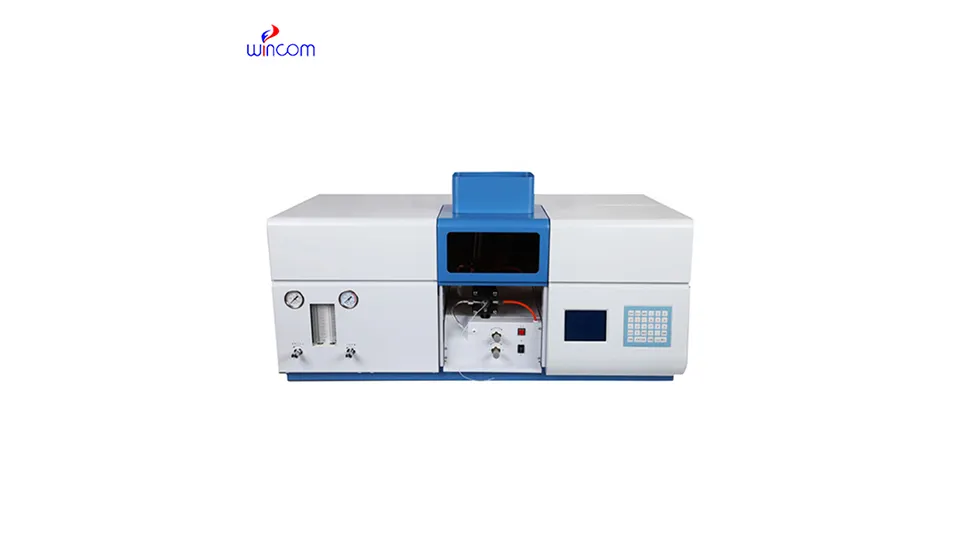
The instrument used is an atomic absorption spectrophotometer, which consists of a light source, an atomizer, a monochromator, a background correction system, an automatic sample injection system and a detection system.
1. light source
2. A hollow cathode lamp in which the element to be tested is commonly used as a cathode.
3. atomization device
There are four main types: flame atomizers, graphite furnace atomizers, hydride generation atomizers and cold steam generation atomizers.
★flame atomizer
It consists of main components such as atomizer and combustion lamp head. Its function is to atomize the test article solution into aerosol, mix it with fuel gas, and put it into the flame generated by the burning lamp head to dry, evaporate, and dissociate the test article, so that the elements to be tested form ground atoms. Combustion flames are produced by different types of gas mixtures, and acetylene-air flames are commonly used. Changing the type and proportion of gas and auxiliary gas can control the temperature of the flame to obtain better flame stability and measurement sensitivity.
★graphite furnace atomizer
It consists of electric graphite furnace and power supply. Its function is to dry and ash the test solution, and then undergo high-temperature atomization to form ground state atoms of the elements to be tested. Generally, graphite is used as the heating body, and a protective gas is introduced into the furnace to prevent oxidation and transport sample vapor.
★hydride generator atomizer
It consists of a hydride generator and an atomic absorption cell. It can be used for the determination of arsenic, germanium, lead, cadmium, selenium, tin, antimony and other elements. Its function is to reduce the element to be measured into a hydride with low boiling point and easy decomposition by heat in an acidic medium. The carrier gas is then introduced into an atomic absorption cell composed of a quartz tube, a heater, etc. In the absorption cell, the hydride is heated and decomposed., and form a ground-state atom.
★cold steam generator atomizer
It consists of a mercury vapor generator and an atomic absorption cell, specially used for the determination of mercury. Its function is to reduce mercury ions in the test solution to mercury vapor. The carrier gas was then introduced into a quartz atomic absorption cell for measurement.
4. monochromator
Its function is to separate the required electromagnetic radiation from the electromagnetic radiation emitted by the light source. The optical path of the instrument should be able to ensure good spectral resolution and the ability to operate normally in a relatively narrow spectral band (0.2nm). The wavelength range is generally 190.0-900.0nm.
5. background correction system
Background interference is a common phenomenon in atomic absorption measurements. Background absorption usually comes from the thermal emission, light absorption and light scattering of the coexisting components in the sample and their secondary molecules or atoms formed during the atomization process. These disturbances should be overcome during instrument design. There are four commonly used background correction methods: continuous light source (usually using deuterium lamps in the ultraviolet region), Zeeman effect, self-absorption effect, non-absorption line, etc.
In atomic absorption spectrophotometry, attention must be paid to interference with the determination caused by background and other reasons. Changes in certain operating conditions of the instrument (such as wavelength, slit, atomization conditions, etc.) can affect sensitivity, stability, and interference. In flame atomic absorption spectrometry, interference can be eliminated by selecting suitable determination lines and slits, changing flame temperature, adding complexing agent or releasing agent, adopting standard addition method, etc. In graphite furnace atomic absorption spectrometry, interference can be eliminated by selecting suitable background correction system, adding suitable matrix modifier, etc. Specific methods shall be selected according to the provisions under each variety.
6. detection system
It consists of a detector, signal processor and indicator recorder. It should have high sensitivity and good stability, and be able to track rapid changes in absorbed signals in time.
① High sensitivity
② Good precision
③ Wide measurement range: more than 70 elements can be measured
④ Less interference, the atomic absorption spectrum is a discrete sharp line spectrum, with less overlap of spectral lines and less interference
⑤Less sample consumption: Graphite furnace flameless atomic absorption method is used, and only 5 - 20μl of test solution or 0.05 - 10mg of solid sample is needed for each measurement.
⑥Fast, simple and easy to automate: Liquid samples can often be injected directly, and general samples do not need to be pre-separated. All injection and determination steps of new models of commercial instruments are automated.
(1)Determination of trace elements in hair--Relationship between trace elements and health
(2)Determination of trace elements in water--Distribution of heavy metal pollution in the environment
(3)Determination of trace elements in fruits and vegetables
(4)Determination of trace elements in minerals, alloys and various materials
(5)Determination of trace elements in various biological samples
E-mail: [email protected]
Tel: +86-731-84176622
+86-731-84136655
Address: Rm.1507,Xinsancheng Plaza. No.58, Renmin Road(E),Changsha,Hunan,China


 EN
EN
 af
af
 es
es
 ar
ar
 tr
tr
 sw
sw
 pt
pt
 th
th
 ur
ur
 bn
bn
 ne
ne
 vi
vi
 km
km
 lo
lo
 de
de
 ru
ru
 fi
fi
 nl
nl
 fa
fa
 fr
fr
 ko
ko



