
Blog
Technical guide for laboratory managers, method developers, and HPLC procurement teams
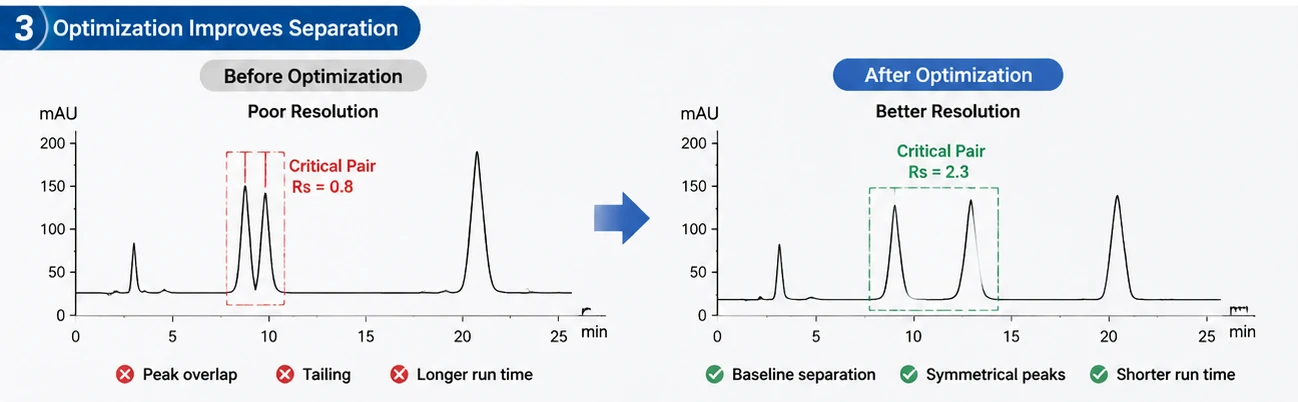
Better HPLC separation rarely comes from changing one setting at random. Start by defining the critical pair, the required reporting limit, and the acceptance criteria; then screen selectivity, organic composition, pH, flow rate, injection load, and temperature in that order. For routine work, a stable isocratic method is often easier to transfer and validate. When late-eluting compounds or a wide polarity range make run time excessive, a gradient may be justified. The practical goal is a method that resolves the critical peaks with repeatable retention and peak area, while staying inside the pressure, detector, column, and sample constraints of your instrument.
Record the symptom: co-elution, tailing, drifting retention, backpressure, weak response, or excessive run time. Identify the peak pair that matters to the release or research decision. Improving a minor impurity while sacrificing that pair is not an improvement.
Set measurable targets: retention repeatability, area precision, critical-pair resolution, tailing, plates, and cycle time. Record sample solvent, concentration, injection volume, column dimensions, additives, and wavelength so selectivity changes can be separated from preparation variability.
Selectivity usually has more leverage than a small flow-rate adjustment. For reversed-phase assays, compare stationary phases with controlled dimensions and particle size. C18 is a useful starting point, not a universal answer; basic, acidic, and highly polar analytes may need another phase or additive system.
Control pH with a defined buffer and verify that the final pH is measured in the intended aqueous component. Small pH shifts can change analyte ionization and therefore retention and selectivity. Keep buffer concentration, preparation order, filtration, and storage consistent. If the method uses volatile additives, check detector compatibility and source cleanliness before comparing results.
Screen solvent identity and proportion separately. Acetonitrile and methanol can show different selectivity at similar elution strength. Change one factor at a time or use a small design, then confirm the result with fresh mobile phase. A stronger solvent may shorten the run but compress the critical pair.
Use isocratic elution when the sample has a narrow retention window and transfer simplicity matters. Constant composition simplifies equilibration and troubleshooting. Gradient elution helps when early peaks need weak conditions but late compounds create a long tail; it adds dwell-volume and re-equilibration variables.
For isocratic work, optimize organic percentage around the critical pair and verify adequate first-peak retention. For a gradient, define the starting composition, ramp, wash, and re-equilibration time. If dwell volumes differ between instruments, match the time at the column inlet rather than copying only the programmed table.
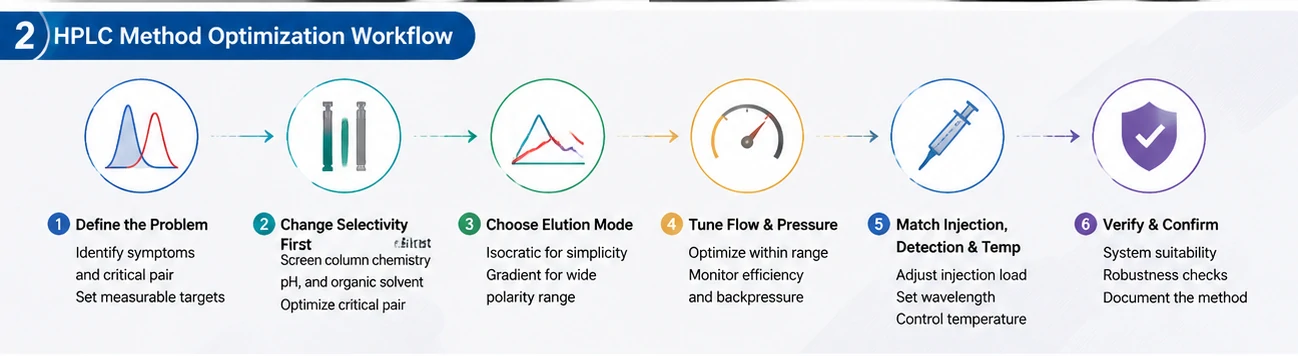
Flow rate affects efficiency, pressure, and analysis time. Begin near the column supplier's recommended range, then test a narrow low-to-high window while watching resolution and backpressure. A lower flow can improve efficiency in some conditions but lengthens the run; a higher flow may increase throughput while reducing efficiency or exceeding the pressure limit. Treat pressure as a hard operating constraint, not a performance target.
The ChroMini HPLC LC-80MI has a 0.001-5.000 mL/min flow-rate range, flow accuracy of <= +/-0.1% under the stated test condition, flow precision of RSD <=0.5%, and a maximum pressure of 5800 psi. Those published values help define an instrument-side screening window, but they do not replace confirmation that your chosen column, viscosity, temperature, and mobile phase remain within safe limits. Record pressure at the final method, after equilibration, and with a clean system so future drift is easier to diagnose.
Injection volume and solvent strength can create fronting, splitting, or distorted early peaks. Keep the sample solvent no stronger than the initial mobile phase when practical, reduce injection volume for overloaded peaks, and confirm concentration against the detector's linear working range. Prepare replicate vials from the same solution before changing the chromatographic conditions; otherwise preparation variability can masquerade as a separation problem.
Set the UV wavelength from the analyte spectrum or a validated method, not from a generic default. The Wincom LC-80MI specifies a UV detector range of 190-680 nm and lists wavelength accuracy of +/-1 nm and precision below 0.1 nm. These are useful instrument facts for method planning, while actual sensitivity still depends on analyte absorptivity, concentration, flow-cell conditions, and noise in the complete method.
Temperature can stabilize viscosity and retention, but it is not automatically a cure for poor selectivity. The LC-80MI’s thermostated column compartment is optional. Confirm its range, stability, calibration evidence, and compatibility with your column and mobile phase before specifying it.
After selecting conditions, run replicate standard or system-suitability injections. Define limits before reviewing results. Track critical-pair resolution, retention repeatability, area precision, tailing, and plate count. Inject a blank for carryover and a representative matrix preparation for interference.
Test robustness around the set point for organic percentage, pH, flow, temperature, wavelength, and injection volume. Use realistic changes and identify the variable that threatens the critical result first. Document column lot, mobile-phase preparation, equilibration volume, configuration, and processing rules.
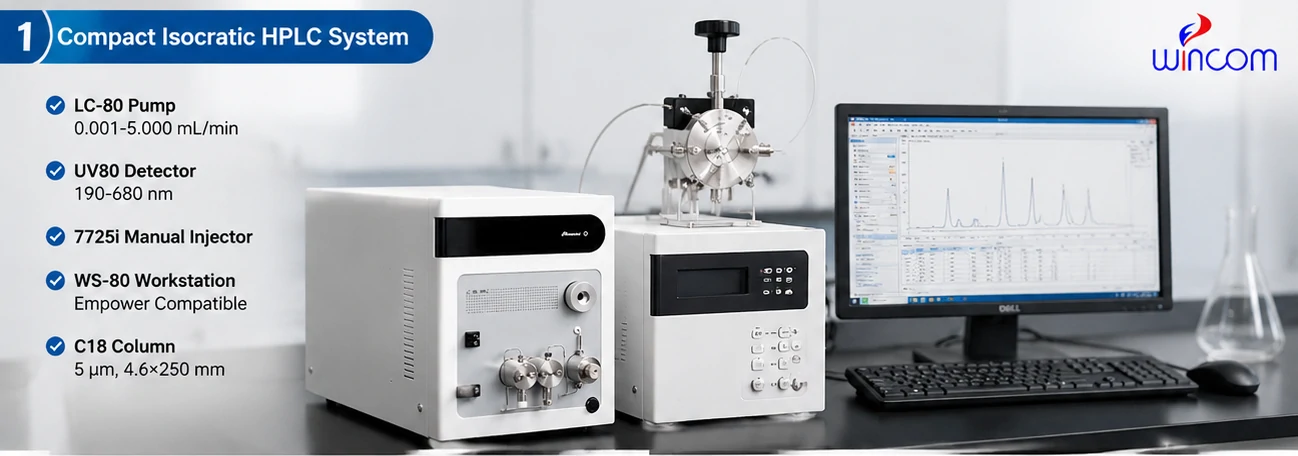
Our ChroMini HPLC LC-80MI is an all-in-one isocratic system combining the LC-80 pump, UV80 detector, 7725i manual injector, WS-80 workstation, and a C18 5 µm ID 4.6×250 mm column. Its configuration provides 0.001-5.000 mL/min flow control, up to 5800 psi maximum pressure, and UV detection from 190-680 nm.
Use the ChroMini HPLC LC-80MI product page to check the listed configuration, then send us your analyte names, column chemistry, mobile-phase recipe, concentration, injection volume, target resolution, and expected sample throughput through our contact page . We can then confirm whether the published configuration is an appropriate starting point, whether the optional thermostated column compartment is needed, and which documentation or accessories should be included in the quotation.
| Variable | What to monitor | Buyer decision |
|---|---|---|
| Selectivity | Critical-pair resolution and retention | Change chemistry, pH, or solvent before forcing flow changes |
| Flow and pressure | Runtime, efficiency, pressure trend | Stay inside the column and instrument operating window |
| Injection and detection | Peak shape, area precision, response | Match solvent strength, load, and wavelength to the sample |
| Robustness | Suitability results after small condition changes | Document the variable most likely to break the method |
Switch when a constant composition cannot retain early compounds adequately and elute late compounds in a reasonable cycle time, or when selectivity across the sample range remains poor. If transfer simplicity and routine robustness dominate, keep an isocratic method where it meets the critical-pair target. We can review the proposed gradient with your column dimensions, dwell volume, and re-equilibration requirement through the HPLC equipment category .
The published UV80 range is 190-680 nm, so a method requiring a wavelength in that interval is within the stated detector range. Confirm your analyte response, mobile-phase absorbance, flow-cell conditions, and noise acceptance with a system-suitability test before treating the method as validated. See the LC-80MI specifications .
No. The listed C18 5 µm, 4.6×250 mm column is a defined starting configuration, not proof of universal analyte compatibility. Provide analyte polarity, pKa, matrix, target resolution, and any restricted solvents so we can confirm whether the supplied column is appropriate or another stationary phase should be quoted. Start with the laboratory equipment range and include those conditions in your inquiry.
E-mail: [email protected]
Tel: +86-731-84176622
+86-731-84136655
Address: Rm.1507,Xinsancheng Plaza. No.58, Renmin Road(E),Changsha,Hunan,China


 EN
EN
 af
af
 es
es
 ar
ar
 tr
tr
 sw
sw
 pt
pt
 th
th
 ur
ur
 bn
bn
 ne
ne
 vi
vi
 km
km
 lo
lo
 de
de
 ru
ru
 fi
fi
 nl
nl
 fa
fa
 fr
fr
 ko
ko