
Blog
Most problems with arm crutches start before the first step: the crutches are the wrong length, the handgrips sit at the wrong height, and the user walks before learning a safe gait. The fixes are simple but specific: size the crutches to the user, carry weight through the hands rather than the forearm or armpit, follow the clinician's weight-bearing rule, and check the tips and fasteners before each use. The sections below list the most common mistakes, what each one costs you, and the exact correction.
A crutch that is too tall forces you to shrug the shoulder and lean; too short makes you stoop and overload the wrists. The standard check is to stand upright in shoes, relax the arms, and set the handgrip so it meets the wrist crease with the elbow bent about 20 to 30 degrees. Arm-crutch length is not one number but a range, and a child and a tall adult need different bands. Wincom's WN7500(L) arm crutches are offered in three height sizes — S (95-113 cm), M (118-138 cm), and L (113-153 cm) — so the first step is matching the measured user to one of those bands rather than assuming a single 'standard' crutch fits everyone.
Buying on listed height alone still misses the mark if the user wears thick-soled shoes or uses the crutches barefoot at home. Measure in the footwear they will actually walk in, and re-check after any cast or boot change, because a plaster cast can add several centimetres to the effective leg length and push the gait off balance.
⭐ Recommended
Arm Crutches | Wincom WN7500(L)
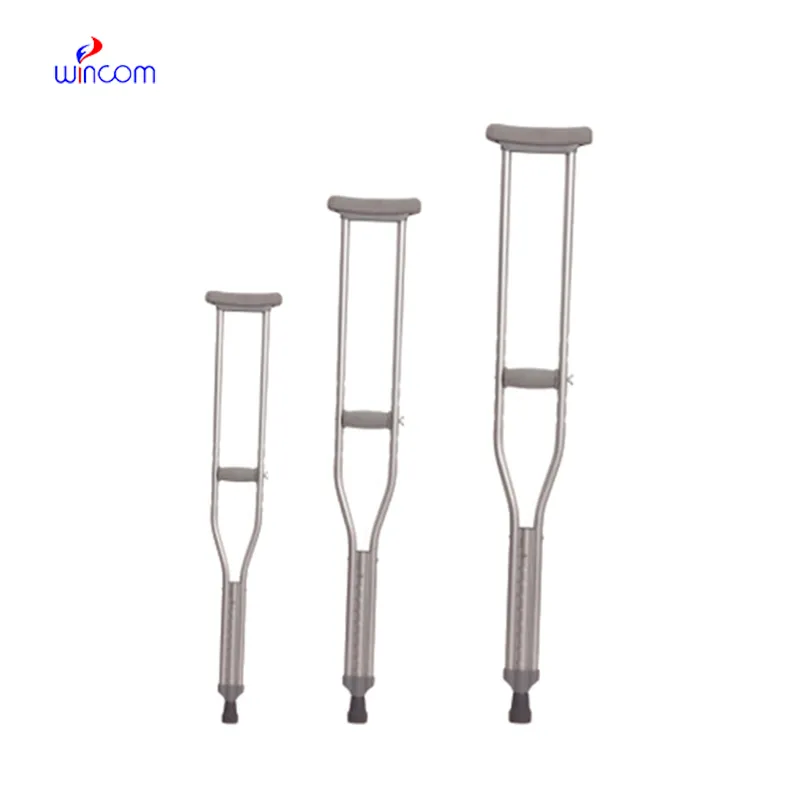
Wincom's Arm Crutches WN7500(L) are offered in three height-adjustable sizes — S (95-113 cm), M (118-138 cm), and L (113-153 cm) — with a transport dimension of 138 x 32 x 28 cm for the large size. They are positioned for hospital, clinic, and home mobility support, and sit within Wincom's broader rehabilitation range alongside walking sticks and other assistive products. Confirming the correct size and any fitting accessories with the supplier helps match the crutch to the user's measured height and daily footwear.
Crutches are a hand tool. The palms and wrists should take the load through the grips, with the arms as shock absorbers, not posts. A common error is to hang from the forearm cuff or, on underarm models, to press into the axillary pad — both shift force into nerves and soft tissue never meant to bear it. After a few hours this shows up as numb fingers, aching shoulders, or a bruised chest wall.
The correction is posture, not strength: keep the shoulders down, grip lightly but firmly, and let the elbow bend slightly as you step. If you cannot hold the grip without the forearm going numb, the crutch is the wrong length or the cuff is positioned incorrectly — stop and re-fit rather than pushing through the soreness.
Even well-fitted crutches fail if the sequence is wrong. The safe pattern moves the crutches forward with the injured leg and keeps the good leg doing the work; advancing both far ahead, or swinging the body between them like a pendulum, wastes energy and invites a fall. Users also watch their feet instead of the path, which is exactly when a rug edge or a step appears.
A short session with a clinician or therapist turns the motion into muscle memory, and most falls happen in the first week at home rather than in the clinic. Ask for a practice round on stairs and slopes before discharge, because the stair technique — up with the good leg, down with the bad, crutches and injured side together — is the part people forget under stress.
The prescription decides how the crutch is used: non-weight-bearing, partial, or weight-bearing-as-tolerated are different plans, and mixing them up is how a healing fracture is re-injured. A partial-weight-bearing instruction means the injured leg still touches the floor with limited force, not that the crutches take everything while the foot dangles. Confirm the exact limit with the treating clinician and write it where the user will see it.
There is a real trade-off between how much the crutches offload the limb and how stable the user feels. Over-reliance hides a wobble that surfaces the moment a hand is needed for a door or rail; partial plans that keep the leg engaged build safer balance. Match the gait to the prescription, not to how tired the user is.
Crutches assume a stable base. Slip-on shoes, heels, or bare feet remove it, and carrying a bag in the hand destroys the two-point support the gait depends on. The fix is mundane but decisive: wear laced, low-heeled shoes with a non-slip sole, and move items in a backpack or a waist pouch, or ask for help. Small changes here prevent a large share of avoidable tumbles.
Home layout matters too. Loose rugs, trailing cables, and wet or uneven floors are where crutch tips lose purchase. Clear a path before the user comes home, fit a shower chair or rail where needed, and treat any 'just for a second' reach across a cluttered room as the moment a fall happens.
Crutches are medical devices that take daily abuse, yet they are rarely inspected. Before each use, confirm the tips are not worn smooth, the ferrule grips the floor, the fasteners are tight, and the height lock holds without slipping. A tip that slides on a tiled floor or a clamp that creeps down mid-step is a fall waiting to happen, and neither is obvious until weight lands on it.
Replace worn ferrules promptly and keep a spare, since the rubber wears fastest at the front edge from the toe-off push. If a crutch arrives with unclear adjustment limits, load rating, or cuff fit, confirm those specifics with the supplier before routine use rather than assuming the hardware matches the prescription. Browse the full Arm Crutches range to compare sizes and related mobility aids.
Not sure the crutches fit the user?
Send us the user's height, the footwear they wear day to day, the prescribed weight-bearing level, and any cast or boot in use. Wincom can confirm which WN7500(L) size band matches the measurement and what fitting details to check before first use.
Or review the Wincom WN7500(L) product page and browse the Arm Crutches range.
Stand in the shoes you will walk in, relax your arms, and set the handgrip to the wrist crease with the elbow bent about 20 to 30 degrees.
The public product information confirms the size ranges, not a load or weight-bearing rating. Confirm the rated load, the user's weight, and the prescribed level with Wincom before use. A crutch supports mobility, but the clinician's prescription sets how much force the injured leg may bear. See the WN7500(L) product page for the current specification.
Confirm the tips are not worn smooth, the ferrule grips the floor, the fasteners are tight, and the height lock holds without slipping. Replace worn rubber promptly. If the adjustment limits or load rating are unclear for your user, ask the supplier to confirm them before routine use.
Yes, with the correct technique: go up with the good leg first, come down with the injured side and both crutches together. But the device alone does not make stairs safe — practice on stairs with a clinician before going home, because that is the sequence most people forget under stress.
Measure the user in their daily footwear, match the result to a size band such as the WN7500(L) S/M/L ranges, and for model-specific load, cuff, or fit details contact Wincom.
E-mail: [email protected]
Tel: +86-731-84176622
+86-731-84136655
Address: Rm.1507,Xinsancheng Plaza. No.58, Renmin Road(E),Changsha,Hunan,China


 EN
EN
 af
af
 es
es
 ar
ar
 tr
tr
 sw
sw
 pt
pt
 th
th
 ur
ur
 bn
bn
 ne
ne
 vi
vi
 km
km
 lo
lo
 de
de
 ru
ru
 fi
fi
 nl
nl
 fa
fa
 fr
fr
 ko
ko