Blog
When choosing a magnifying glass, there is no standard answer to the question of "what is the best magnification factor". Different usage scenarios, vision requirements, and optical characteristics determine the optimal magnification for a magnifying glass. This article provides you with a systematic selection plan from scientific principles to practical applications.
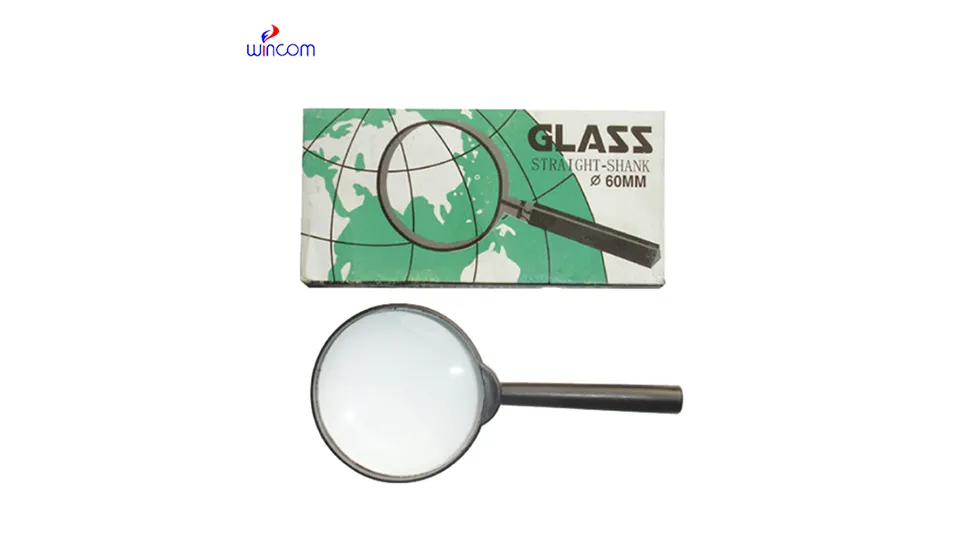
The magnification factor of a magnifying glass is determined by the curvature of the lens and the focal length. According to the formula, magnification factor = 1 + 25/f (f is the focal length, in centimeters), the shorter the focal length, the higher the magnification. For example:
30x magnifying glass: focal length needs to be 0.86 cm, the lens is thick and the field of view is very small (diameter about 6mm).
10x magnifying glass: focal length 2.5 cm, the field of view can reach 23mm, balancing both magnification effect and observation range.
However, higher magnification is not always better. Magnifying glasses with a multiple of 15 or more require multiple layers of lenses, and a single layer lens is prone to spherical distortion; magnifying glasses with a multiple of 30 or more need a focusing device to avoid blurry images. Additionally, higher magnification leads to a shallower depth of field (a narrower range of clear imaging), and precise control of the observation distance is required.
Reading and browsing (2-5x)
Applicable scenarios: reading newspapers, drug instructions, mobile phone messages, etc.
Advantages: wide field of view (lens diameter ≥ 5cm), able to clearly see the entire text at once. For example, a 3x magnifying glass with a 6cm diameter lens provides a reading experience close to normal vision.
Recommended product: resin lens magnifying glass (lightweight and shock-resistant), with anti-slip handle and adjustable focal length function, suitable for the elderly.
Handicraft and DIY (5-10x)
Applicable scenarios: stringing beads, cross-stitching, model assembly, etc.
Technical points: choose magnifying glasses with LED lighting (brightness ≥ 500 lumens) to avoid shadow interference; the lens transmittance needs to be > 92%, reducing color distortion.
Jewelry and artifact appraisal (10-40x)
Industry standard: international jewelry appraisal regulations require the use of 10x magnifying glasses as the basic tool to observe gemstone inclusions, jade砣 work traces, etc.
Advanced requirements: 20-40x magnifying glasses can identify porcelain glaze bubble aging states, bronze rusting crystallization forms, etc., requiring a stable stand (such as spoon design) to reduce shaking.
Pitfall guide: avoid purchasing cheap products with a claimed 60x magnification, as these magnifying glasses usually have severe distortion, which instead affects the accuracy of appraisal.
Electronic repair and industrial inspection (5-20x)
Typical application: inspecting circuit board solder joints, textile fibers, printing dots, etc.
Key indicators: the lens needs to pass water degradation test (boiling 100°C water for 24 hours without cracking), tensile strength ≥ 15N/mm. For example, the Karand 20x double-lamp magnifying glass uses rare earth lanthanide lens, which can clearly present sub-surface structures.
Scientific research and medical (20x or above)
Special requirements: for observing microorganisms, cell sections, 50-100x professional magnifying glasses (actually simple microscopes) are needed, equipped with rulers and coaxial lighting systems.
Notes: high-power magnifiers need to be used with a stage, to avoid image blurring caused by hand shaking.
Low vision:
0.03-0.05 vision: requires 10x or higher optical magnifying glasses or electronic visual aids, combined with an inclined writing board.
0.25-0.3 vision: 3-5x magnifying glasses can meet reading needs, prefer to choose diffraction lenses (thickness reduced by 75%, field of view increased by 25%).
Presbyopic patients:
Mild: 2-3x; moderate: 4-6x; severe: 8-10x, recommend having an eye examination first before choosing.
Children: choose 2-3x cartoon-shaped magnifying glasses, lens diameter ≥ 8cm, to avoid frustration due to too small a field of view.
Older adults: prefer products with LED lighting and anti-slip handles, such as the Yishibao 12.5x magnifying glass using PXM ultra-light material, weighing only 150 grams.
Optical Glass: Transmittance > 95%, low dispersion, suitable for professional scenarios (such as the German Lighthouse series).
Resin / PC: Lightweight and shock-resistant, but the surface is prone to scratches. Choose products with reinforced coating (such as anti-scratch ceramic coating).
Process: The observation lenses have no bubbles, smooth edges, and no rainbow-like reflective light (indicating no coating defects).
LED Light Source:
Brightness: ≥ 300 lumens, supports three-level adjustment, avoiding strong light stimulation.
Color Temperature: 4000 - 6500K (cold white light) suitable for detailed observation, 3000K (warm light) reduces visual fatigue.
Lighting Mode: Side light is suitable for observing surface textures, coaxial light is suitable for transparent objects (such as the interior of gemstones).
Handle: Diameter ≥ 3cm, anti-slip treatment on the surface, does not slip even when held for a long time (such as rubber coating design).
Frame: Metal material (such as aluminum alloy) is more durable, weighs less than 200 grams, avoiding wrist fatigue caused by long-term use.
Test Report: Require merchants to provide proof of water resistance grade ≥ 3 and wear resistance ≥ 400,000 times.
Actual Test: Observe newspaper text with a magnifying glass. If the edges have no obvious deformation and the color reproduction is accurate, it is a qualified product.
Recommended Combination: 5x folding magnifying glass (weight < 100 grams) + 10x single-tube telescope, used for observing plant details and distant terrain.
Special Requirements: The lenses need to pass IPX4 waterproof test, able to be used normally in humid environments.
Basic Model: Hundred-yuan-level optical magnifying glass (5 - 10x), used for preliminary screening of handwriting direction and seal outline.
Advanced Model: Thousand-yuan-level LED lighting magnifying glass (20 - 50x), adjustable brightness and angle, equipped with ruler and external photo-taking function, meeting judicial identification needs.
Auxiliary Tools:
Electronic Aids: Suitable for vision below 0.1, adjustable contrast and magnification (such as 12 - 20x), supports color inversion mode.
Glasses-type Aids: 4 - 12D degrees, freeing hands, suitable for reading and writing.
Environmental Optimization: Use AA-grade eye-protection lamps (no flicker, low blue light), desk illumination ≥ 500 lux.
1. Misunderstanding: The higher the magnification, the clearer the image
Truth: Beyond 20x, the impact of lens processing accuracy and lighting conditions on clarity exceeds the magnification itself. For example, a supposedly 50x magnifying glass may have actual imaging clarity lower than a high-quality 10x lens.
2. Misunderstanding: All high-magnification lenses require batteries
Truth: Pure optical magnifying glasses do not require power, but magnifications usually ≤ 20x. 30x or above magnification without LED lighting may only rely on natural light, with limited usage scenarios.
3. Misunderstanding: The higher the magnification for children, the better
Truth: Children's vision development is not yet mature. High-magnification magnifying glasses can easily cause eye fatigue. It is recommended to choose 2 - 3x, with a lens diameter ≥ 8cm, to cultivate observation interest while protecting vision.
The "optimal magnification" of a magnifying glass is the result of a combination of the scene, vision, and budget. For daily use, a lightweight model with a magnification of 2-5 times is preferred. In professional fields, a high-precision product with a magnification of 10-40 times should be selected based on specific needs. Regardless of the magnification chosen, attention should be paid to the quality of the lens, the lighting system, and the ergonomic design to avoid falling into the trap of the "only magnification matters" mindset. Remember: The suitable one is the best one.
E-mail: [email protected]
Tel: +86-731-84176622
+86-731-84136655
Address: Rm.1507,Xinsancheng Plaza. No.58, Renmin Road(E),Changsha,Hunan,China


 EN
EN
 af
af
 es
es
 ar
ar
 tr
tr
 sw
sw
 pt
pt
 th
th
 ur
ur
 bn
bn
 ne
ne
 vi
vi
 km
km
 lo
lo
 de
de
 ru
ru
 fi
fi
 nl
nl
 fa
fa
 fr
fr
 ko
ko