
Blog
Choose a human model by matching its procedure coverage to the skills your curriculum assesses, then verify consumable parts, cleaning, and spare-part support before you compare price. Two simulators can look alike in a catalogue and behave very differently across a semester. This method runs in one meeting: map the curriculum to the function list, test the lab's physical and cleaning constraints, then qualify the supplier on parts and documentation. It is written for nursing schools, skills labs, and hospital training centres buying for years of use.
Begin with a crosswalk. List every procedure your programme teaches and marks, then separate the ones students must be assessed on from those only demonstrated. A model earns its place by covering the assessed list, not the longest list.
The Wincom WN-M-130A male simulator is built around thirteen procedure groups: hair and facial washing with eye and ear care, oral and denture care, oral, nasal and tracheal intubation, suctioning, oxygen inhalation, oral and nasal feeding, gastric lavage, arm vein puncture and infusion, deltoid, lateral femoral and hip intramuscular injection, enema, thoracic, abdominal, liver, bone marrow and lumbar puncture, catheterization and bladder flushing, fistulation and drainage, and overall care such as bathing and changing clothes. The wider human models range matters, because a shorter task trainer may cover your assessed list at lower cost and smaller footprint.
A full-function simulator replaces several single-task trainers and keeps one body in front of the student through a whole care sequence, closer to ward work. It also costs more and resets slower. If your assessed list is short, buy the task trainer and spend the difference on a second unit so more students practise at once.
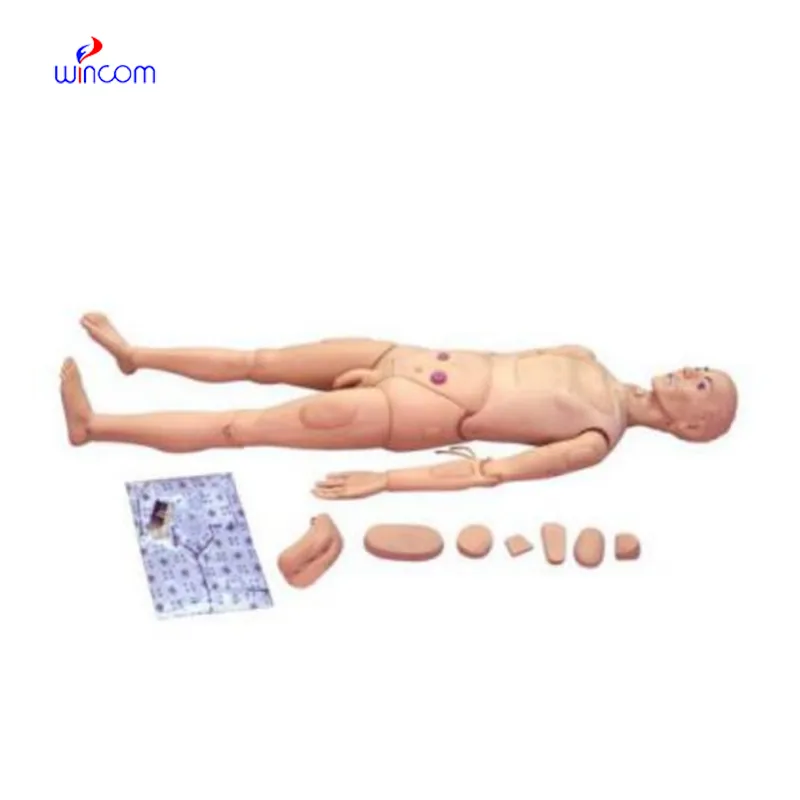
A male simulator covers male catheterization and male anatomy. If your curriculum also assesses female catheterization, one male model cannot complete that objective. Ask whether a female counterpart exists in the same series and whether the two share consumables, because shared parts reduce stock lines and instructor training.
Body format changes daily use more than any brochure figure. Overall care such as bathing, positioning, and changing clothes needs a body you can move and dress; a torso cannot carry those sessions, but it is lighter, easier to store, and faster to clean. With short sessions and high turnover, a torso may be the more honest choice.
Catheterization, bladder flushing, enema, gastric lavage, suctioning, and oral or nasal feeding all move fluid through the model. That is where a cheap purchase becomes expensive: every fluid path needs a replaceable insert, a drainage route, and a drying method.
Ask four questions before you commit. Which parts are consumable: the bladder insert, the rectal insert, the feeding and suction lines? What does a replacement set cost, and how fast does a cohort wear one out? How does the lab drain and dry the model, and how many hours does that take? What happens if fluid is left inside over a weekend?
This is a constraint, not a detail. A lab without drainage and drying space stops using the fluid functions within a term, and the model becomes an expensive injection pad. If space is limited, plan a wet area before you buy.
The parts that wear are predictable: the arm vein pad, deltoid pad, lateral femoral and hip injection sites, and every joint that holds a limb in position. Ask for the replacement list and the price of each item in the same conversation as the model quote.
Ask for material and cleaning instructions too. You need to know which disinfectants the skin accepts, whether the surface resists staining from iodine and blood simulant, and whether written cleaning guidance exists for your infection-control committee. Without that documentation, a model can fail an audit even when it works.
Joints deserve a physical test. Ask for the range of motion, whether the joints lock, and how much force holds a limb raised. A model that cannot hold a position forces a second pair of hands into every session.

Count students per session and minutes per reset. A full-function model with fluid tasks needs setup, drainage, drying, and consumable replacement between students, so one unit may serve fewer learners than the timetable assumes. Two simpler units often beat one flagship unit on completed practice attempts.
The room around the model decides whether the purchase works. An examination bed at a workable height, an infusion stand for infusion and transfusion sessions, and an instrument trolley that keeps consumables within reach turn a simulator into a station. Reusable items need an autoclave sterilizer and drying space, and the room needs storage so the model is not left on a bed between classes.
Measure before you order. Confirm dimensions and weight against door widths, lift access, and storage height. A simulator that cannot reach the classroom gets used less.
If your assessed list spans medical-surgical care, injection and infusion, airway and feeding, catheterization, and overall patient care, a full-function simulator removes the handoff between task trainers. The WN-M-130A is the male option in that class.
⭐ Recommended Full Function Nursing Training Simulator | Wincom WN-M-130A
Wincom's Full Function Nursing Training Simulator WN-M-130A is positioned for nursing schools, clinical skills labs, and hospital training centres that need one male simulator to carry core medical-surgical skills across a cohort. Its thirteen procedure groups span airway and feeding, injection and infusion, puncture, catheterization and drainage, and overall care such as bathing and changing clothes. That breadth suits programmes that want students to move through a care sequence on one body instead of switching between task trainers, and it keeps the supplier conversation on consumables, cleaning, and spare parts.
Use the same six checks for every model on your shortlist; a failed row rules out a price comparison.
| Check | Pass condition |
|---|---|
| Curriculum coverage | Every assessed procedure appears on the written function list. |
| Anatomy variant | Male and female needs are both covered, or the second model is budgeted. |
| Consumables | Replacement parts, prices, and expected wear rate are confirmed in writing. |
| Cleaning | Material, disinfectant compatibility, drainage, and drying time are confirmed. |
| Space and handling | Dimensions and weight fit doors, lift, storage, and bench height. |
| Supplier support | Spare-part lead time, documentation, warranty, and lead-time start point are confirmed. |
Need help matching a model to your curriculum?
Send the procedures your programme assesses and how many students practise per week. Wincom will confirm which WN-M-130A functions match that list, which parts are consumable, and which bench equipment the room still needs.
Contact UsCover the procedures your programme assesses, not the longest list you can find. Thirteen procedure groups help only when they map to your curriculum. If five are assessed, a shorter trainer plus a second unit gives more practice time per session.
It depends on whether you teach overall care. Bathing, positioning, and changing clothes need a body you can move and dress, which a torso cannot support. Torso models are lighter, cheaper to store, and faster to clean, so they suit high-turnover injection practice.
Plan for the parts that contact needles and fluid: arm vein and deltoid pads, femoral and hip sites, bladder and rectal inserts, and feeding or suction lines. Ask for the replacement list and unit prices, then estimate wear per cohort rather than per year.
No. A male simulator covers male catheterization only, so female catheterization needs a female model or a dedicated trainer. Ask whether a female counterpart exists in the same series and shares consumables, because shared parts simplify stock and training.
E-mail: [email protected]
Tel: +86-731-84176622
+86-731-84136655
Address: Rm.1507,Xinsancheng Plaza. No.58, Renmin Road(E),Changsha,Hunan,China


 EN
 af
 es
 ar
 tr
 sw
 pt
 th
 ur
 bn
 ne
 vi
 km
 lo
 de
 ru
 fi
 nl
 fa
 fr
 ko