
Blog
A surgical light is one of the hardest-working devices in an operating room, running for hours under heat, moisture and constant disinfection. The same conditions that keep a medical equipment fleet safe also wear a light head down if it is ignored. This guide lays out a practical maintenance and cleaning routine for surgical lights, from daily wipes to quarterly electrical checks, so the lamp keeps its illuminance, color rendering and shadowless performance for years instead of months. It is written for biomedical engineers, OR supervisors and clinic managers who want prevention, not emergency repairs.
Surgical lights fail quietly. A gradual drop in lux, a drifting color temperature, or a sticky articulation arm rarely stops a procedure on day one, but each one erodes the visibility a surgeon depends on. A scheduled routine turns those slow declines into items you catch and correct before they matter.
Good maintenance also protects patients. Disinfection between cases prevents cross-contamination, while stable mechanical joints keep a heavy light head exactly where the team placed it. The time spent on a checklist is small compared with a recalled procedure or a failed lamp mid-surgery.
Cleaning is the single most repeated task on a surgical light, and doing it the same way every case is what keeps both the lens and the disinfection log compliant. Treat this as the baseline before the first incision of the day and after the last case.
Between daily wipes, a short weekly and monthly pass catches the things daily cleaning misses: the joints, the cabling and the subtle drift in light quality. Log the readings so a slow change becomes obvious.
The light head and its optics are where performance lives. Dust, fingerprints and disinfectant film all scatter light and dull the field, so the optics deserve careful, regular attention rather than aggressive scrubbing.
Whether the lamp is ceiling-mounted or on a mobile trolley, its articulation system carries the most mechanical wear. A sagging or drifting head is a safety risk, so the suspension gets the same discipline as the optics.
Surgical lights sit on critical power. A quarterly electrical check, plus a test of any battery backup, is what keeps the field lit through a power event instead of plunging the theatre into darkness at the worst moment.
Most field complaints are simple and repeatable. Keeping this short reference at the nurse station turns a mid-case panic into a two-minute fix.
A well-built light is easier to maintain because its covers come off cleanly, its handle is sterilizable, and its LEDs are grouped for simple replacement. When specifying new hardware, pair the lamp with the workflow around it, from the examination bed to the patient monitor, so the whole theatre stays serviceable.
⭐ Recommended Operating Lamp | Wincom OL-500LED-SD
Wincom OL-500LED-SD
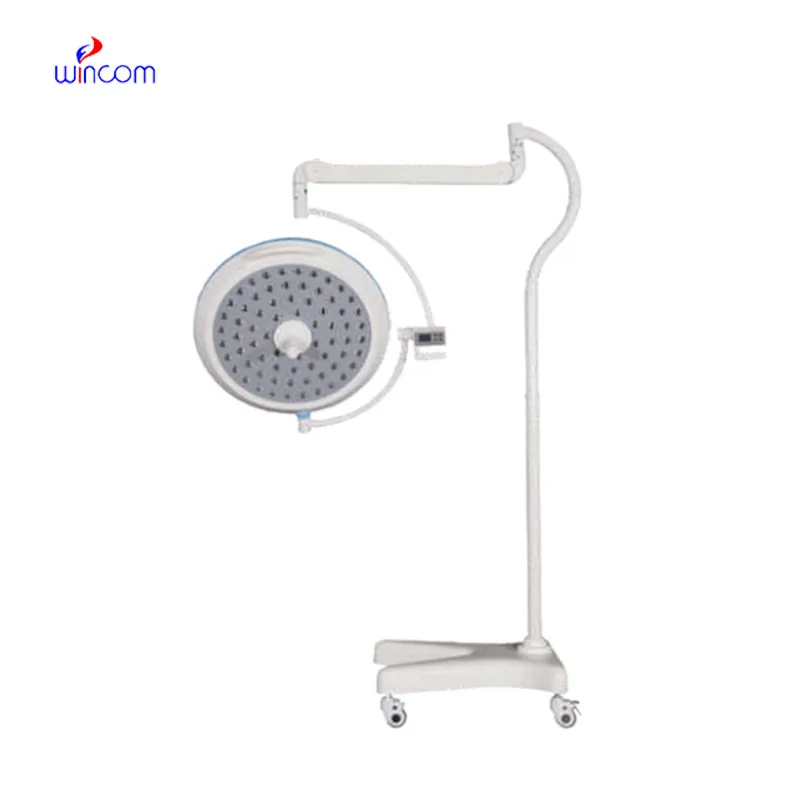
Wincom's Operating Lamp OL-500LED-SD is positioned for hospital operating rooms, surgical suites and clinics that need shadowless, adjustable surgical lighting, with a 500 millimetre light head, 48 LED modules, illuminance adjustable from 40,000 to 160,000 lux, a color rendering index of 96 or higher, and a color temperature range of 3000 to 6700 Kelvin that the surgical team can tune to the procedure. An illumination depth of at least 600 millimetres and a light spot of 160 to 280 millimetres keep the field evenly lit, while temperature rise stays within 1 degree Celsius at the surgeon's head and 2 degrees Celsius at the operating field, reducing fatigue and tissue drying. This makes it suitable for general surgery, minor procedures, obstetrics and examination rooms where reliable, low-heat, true-color light matters, and its serviceable design suits the maintenance routine described above. A larger 700 millimetre, 80 LED head is offered as the OL-700LED-SD for deeper or wider fields.
A surgical light does not operate alone. The furniture, sterilization and waste systems around it decide whether a clean, compliant room stays that way, so they deserve the same routine attention.
A hospital-grade, non-abrasive disinfectant compatible with polycarbonate, applied with a soft lint-free cloth after the head has cooled. Avoid solvents and abrasives that cloud the dome, and never spray liquid directly onto the head.
Record both monthly with a light meter and compare against the baseline. A steady fall signals LED aging or a dirty optic, and catching it early avoids a below-spec field during a procedure.
Loose pivots, a tired counterbalance spring or an undertightened brake. Re-torque the joints, rebalance the arm, and never leave a heavy head loosely braked above a patient.
Visit the OL-500LED-SD product page for the complete specification, or reach our team through the contact channel for advice on surgical lighting, mounting options and the OR equipment listed above.
Need help specifying or maintaining a surgical light?
Tell us your theatre layout, procedure mix and mounting preference. Wincom will recommend the OL-500LED-SD configuration plus the beds, trolleys, sterilization and monitoring equipment for a safe, serviceable operating room.
Or review the Wincom OL-500LED-SD operating lamp and explore our wider operating lamp range and the OL-700LED-SD alternative for larger fields.
E-mail: [email protected]
Tel: +86-731-84176622
+86-731-84136655
Address: Rm.1507,Xinsancheng Plaza. No.58, Renmin Road(E),Changsha,Hunan,China


 EN
 af
 es
 ar
 tr
 sw
 pt
 th
 ur
 bn
 ne
 vi
 km
 lo
 de
 ru
 fi
 nl
 fa
 fr
 ko