
Blog
In the industrial field, infrared thermometers, with their advantages such as non-contact measurement, fast response, and wide temperature measurement range, have become an important tool for ensuring production efficiency, equipment safety, and product quality. Their main applications are as follows:
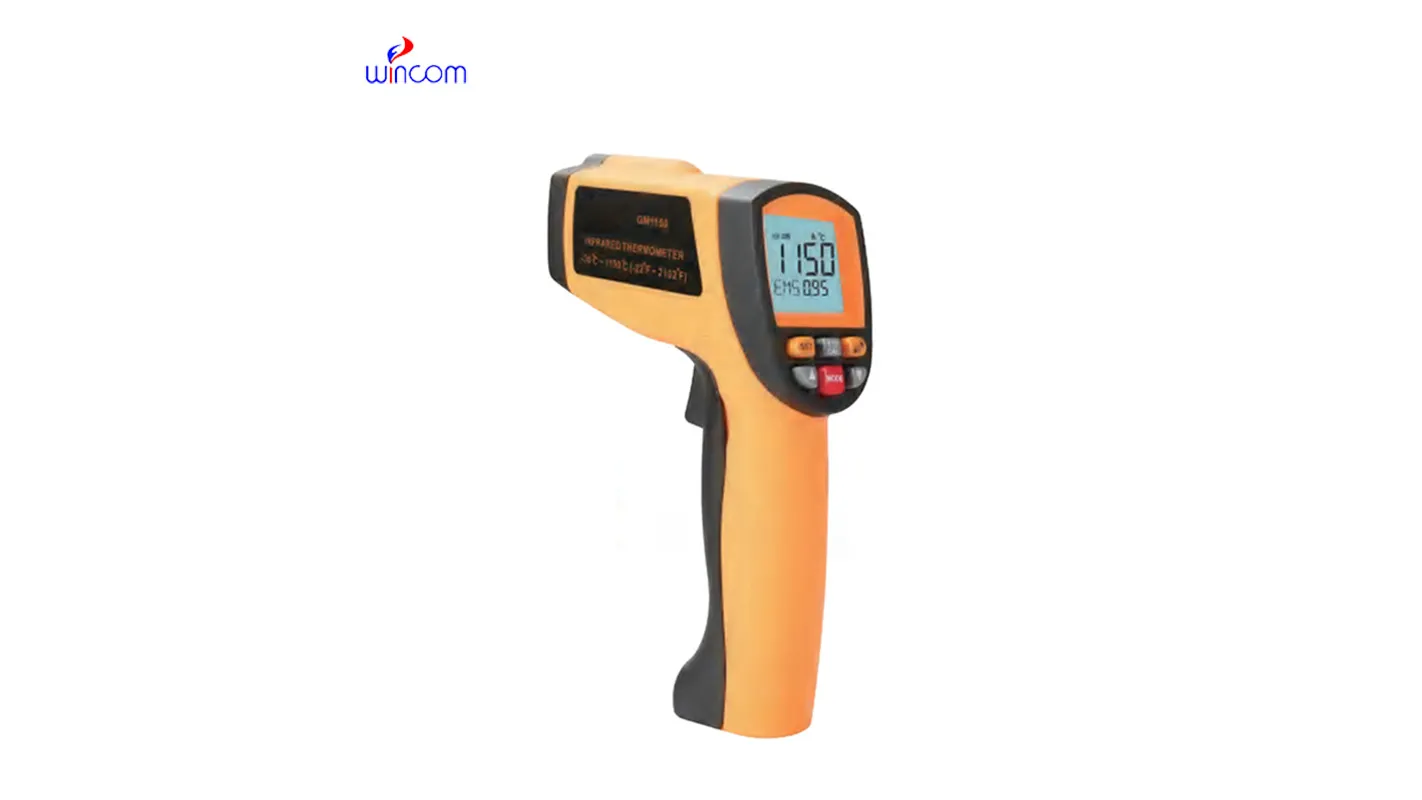
Monitoring of key equipment operating conditions: It is possible to monitor the surface temperatures of industrial equipment such as motors, transformers, switch cabinets, conveyor belt bearings, etc. For instance, overheating of motor windings may indicate bearing wear, excessive load, or aging insulation. Regular infrared temperature measurement can detect abnormal temperature points in a timely manner, preventing equipment from stopping due to overheating or causing fires and other accidents.
Fault detection in electrical systems: In the power system, when electrical connections at wire joints or contact points of circuit breakers are poor, the resistance increases and causes heating. Infrared thermometers can quickly locate the heating areas, such as abnormal temperatures in bushings and cable heads in substations. This helps maintenance personnel carry out maintenance at the early stage of faults, reducing power outages.
Metallurgy and Heat Treatment Industry: During steel rolling and metal forging processes, it is necessary to accurately control the temperature of the billets to ensure material properties. For example, during hot rolling of steel plates, by monitoring the temperatures of the rollers and the steel plates using infrared thermometers, the rolling speed and pressure can be adjusted in real time to avoid insufficient strength of the steel plates due to insufficient temperature, or coarse grain formation due to excessive temperature.
Chemical and Petroleum Processing: The temperatures of materials in reaction vessels and pipelines are key parameters in chemical production. For example, in polymerization reactions, excessively high temperatures may cause polymerization explosion, while excessively low temperatures may affect the reaction rate. Infrared thermometers can non-contactally measure the outer wall temperature of equipment and indirectly monitor the internal reaction status to ensure process stability.
Food and Pharmaceutical Industry: In baking, sterilization and other processes, it is necessary to strictly control the temperature to ensure product quality. For example, during biscuit baking, by monitoring the temperature distribution inside the oven using a thermometer, the power of the heating elements can be adjusted to avoid over-baking or under-baking.
Semiconductor and electronic manufacturing: During the chip packaging and welding processes, the temperature of the solder joints directly affects the reliability of the connection. Infrared thermometers can detect the temperature distribution on the surface of the chips, ensuring that the welding temperature meets the process requirements and preventing problems such as short circuits or detachment.
Material performance assessment: Testing the temperature uniformity of composite materials, coatings, etc. for workpieces. For example, in the production of automotive brake pads, if the temperature of the friction layer is not consistent, it may lead to unstable braking performance. Through infrared thermometry, defective products can be screened.
Measurement in high-temperature or hazardous environments: In high-temperature areas such as blast furnaces and furnaces, or in environments with corrosive or explosive gases, infrared thermometers can avoid the risk of manual contact. For example, measuring the surface temperature of steel ladles in steel mills to ensure the safety of operators.
Fast scanning and large-area monitoring: Combined with infrared thermal imagers, large-area temperature scanning can be conducted on production lines, generating thermal imaging diagrams to visually display temperature distribution.
Check whether the insulation layers of industrial furnaces and pipelines have any heat leakage. If the temperature at the damaged areas of the insulation layers is significantly higher than that of the surrounding areas, repairing them can reduce heat loss and lower energy consumption. Additionally, in air conditioning and refrigeration systems, monitoring the temperatures of condensers and evaporators can optimize the cooling efficiency and save energy.
In conclusion, infrared temperature measurement instruments are applied in various aspects of the industrial field, including equipment maintenance, process control, and quality inspection. Through accurate temperature monitoring, they provide crucial support for the intelligence, safety, and efficiency of industrial production.
E-mail: [email protected]
Tel: +86-731-84176622
+86-731-84136655
Address: Rm.1507,Xinsancheng Plaza. No.58, Renmin Road(E),Changsha,Hunan,China


 EN
EN
 af
af
 es
es
 ar
ar
 tr
tr
 sw
sw
 pt
pt
 th
th
 ur
ur
 bn
bn
 ne
ne
 vi
vi
 km
km
 lo
lo
 de
de
 ru
ru
 fi
fi
 nl
nl
 fa
fa
 fr
fr
 ko
ko



