Oscilloscope is a widely used electronic measuring instrument. It can convert invisible electrical signals into visible images, making it easier for people to study the changing processes of various electrical phenomena.
Some people think that a multimeter is enough to handle everything, so why bother spending time and effort learning about oscilloscopes? In a nutshell, times have changed. The complexity and operating frequency of modern electronic equipment systems are beyond what even a black-and-white TV or radio could compare to in the past. Learning to use an oscilloscope can definitely significantly reduce one's maintenance workload and improve work efficiency.
Moreover, the application of oscilloscopes is not limited to the field of electronics. When appropriate sensors are installed, oscilloscopes can measure various phenomena. Such as sound, mechanical pressure, pressure, light or heat sensors. Medical personnel can also use oscilloscopes to measure brain waves. Therefore, an oscilloscope is a very versatile electronic measuring instrument, and it is by no means an exaggeration.
Today, let's have a general overview of the development history of the oscilloscope.
The history of oscilloscope can be traced back to the 1820s. After coupling a galvanometer with a mechanical plotting system, waveforms were manually recorded. This device consisted of a special single-contact commutator installed on the rotating rotor shaft. The contact points could move around the rotor according to the precise degree indicator scale, and the output appeared on the galvanometer, which was then manually plotted by technicians. Since this process was formed over thousands of wave cycles, it could only produce very rough approximations of the waveforms.
The first automatic oscilloscope used a galvanometer and a pen to capture waveform diagrams onto a continuously moving paper roll. Due to the relatively high frequency of the waveforms compared to the reaction time of mechanical components, the waveforms were not directly plotted as images but were created over a period of time by combining many small segments of different waveforms. It would automatically charge the capacitor from the 100th waveform and record it, and each subsequent charging of the capacitor would start from a point slightly further along the wave. Such waveform measurements were still the average of hundreds of wave cycles, but were more accurate than the previously hand-drawn waveform diagrams.
The analog oscilloscope is mainly based on the cathode ray tube (CRT). The electron beam emitted by it passes through the horizontal and vertical bias systems and strikes the fluorescent substance on the screen to display the waveform.
Cathode ray tube for oscilloscopes:
1. Deflection voltage electrode
2. Electron gun
3. Electron Beam
4. Focus coil
5. The screen is coated with a phosphor layer.
In the 1940s, the development of radar and television required waveform observation tools with excellent performance. Tektronix successfully developed a synchronous oscilloscope with a bandwidth of 10 MHz, which was the foundation of modern oscilloscopes.
A scope with synchronous scanning function
To increase the bandwidth of an analog oscilloscope, it is necessary to comprehensively enhance the performance of the oscilloscope tube, vertical amplification, and horizontal scanning. To improve the bandwidth of a digital oscilloscope, only the performance of the A/D converter at the front end needs to be enhanced. There are no special requirements for the oscilloscope tube and scanning circuit. In addition, digital oscilloscopes can fully utilize memory, storage, and processing capabilities, as well as various triggering and pre-triggering functions. In the 1980s, digital oscilloscopes dominated the market, and many manufacturers stopped producing analog oscilloscopes. Analog oscilloscopes gradually faded from the historical stage.
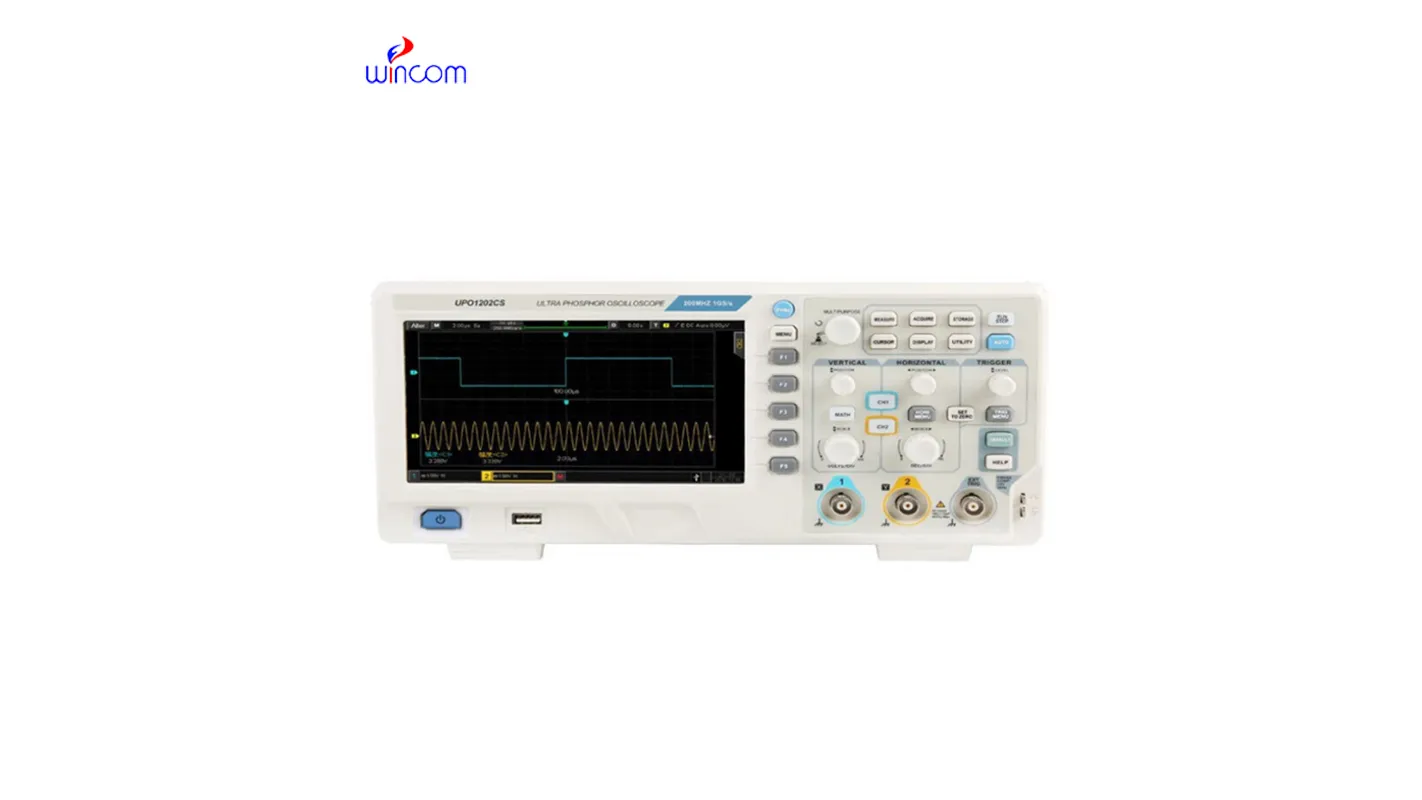
Digital oscilloscopes are high-performance oscilloscopes that are manufactured through a series of technologies such as data acquisition, A/D conversion, and software programming. Digital oscilloscopes usually support multi-level menus, providing users with various options and multiple analysis functions. Some oscilloscopes also offer storage capabilities, allowing for the saving and processing of waveforms.
For oscilloscopes with bandwidths within several hundred megahertz, the oscilloscopes of domestic brands have already been able to compete with foreign brands in terms of performance and have obvious cost-performance advantages.
Digital oscilloscopes have most of the basic functions of analog oscilloscopes. For example, the function of displaying waveforms, the x-Y working mode, the basic triggering methods, etc. They also include features such as trigger delay, the coupling mode of the input signal, the deflection adjustment, and the calibration of the output of the signal source.
Digital oscilloscopes have added several more useful functions compared to analog oscilloscopes. The most common ones include automatic range selection, automatic measurement of various parameters, storage of waveforms and settings status, interface bus, display of average curve fitting (interpolation method), high-pass and low-pass filtering of bandwidth, trigger operation mode and trigger condition selection, and cursor measurement, etc.
In the present era, humanity is undergoing a digital revolution. Emerging technologies such as 5G, the Internet of Things, big data, cloud computing, and artificial intelligence are constantly evolving and developing. The oscilloscope is also experiencing a revolution. The touch operation mode of smartphones, compared to the traditional key presses, has proven to be more efficient. Oscilloscope manufacturers are also considering applying touch technology to oscilloscopes to replace the traditional key and knob operation methods.
The outdated nature of the original technical equipment and the slow improvement of existing technologies have been causing engineers a lot of headaches. The touch oscilloscope has brought engineers a completely new experience of use, significantly enhancing their original working efficiency. This new interactive method enables engineers to quickly identify problems in the entire product design, and can utilize the test results for analysis to discover and solve problems, without having to worry about how to operate the oscilloscope anymore.
E-mail: [email protected]
Tel: +86-731-84176622
+86-731-84136655
Address: Rm.1507,Xinsancheng Plaza. No.58, Renmin Road(E),Changsha,Hunan,China


 EN
EN
 af
af
 es
es
 ar
ar
 tr
tr
 sw
sw
 pt
pt
 th
th
 ur
ur
 bn
bn
 ne
ne
 vi
vi
 km
km
 lo
lo
 de
de
 ru
ru
 fi
fi
 nl
nl
 fa
fa
 fr
fr
 ko
ko