
Blog
Unlike a mere display torso model for use in a physiology lab, an ideal one will be functional and help bring the concept of physiology closer to reality and practicality for schools of medicine, nursing colleges, vocational institutions, and laboratory distributors.
One can spend many hours reading and memorizing facts concerning the thoracic cavity, muscle groups, digestive and urinary systems, but fail to link this theoretical knowledge to clinical practice. Thus, a proper selection of a torso model is necessary. It offers both the teaching staff a reliable instrument, learners a spatial orientation aid, and procurement managers an item that will benefit several courses at once.
Depending on the extent of teaching, a good application of a torso model in physiology laboratories will differ. For some curricula, a simple anatomical torso will suffice for organ recognition. For others, a multifunctional nursing trainer will be required for injections, catheterizations, venipunctures, enemas, and other procedures. Below are five possible uses of a torso model in physiology laboratories.
The first and most familiar use is anatomical orientation. A torso model lets students see how the lungs sit around the heart, how the diaphragm separates thoracic and abdominal structures, and how digestive and urinary organs occupy limited space in the trunk. That physical relationship is difficult to understand from flat diagrams alone.
In a physiology lab, this matters because organ position is tied to function. Respiratory mechanics, circulation, digestion, and elimination all depend on structure. When instructors demonstrate the model while discussing ventilation, blood flow, swallowing, peristalsis, or bladder emptying, students can attach abstract processes to visible regions of the body.
For buyers, removable organs, clear color separation, stable assembly, and durable surface finishing are worth checking before purchase. A model with loose parts, weak labeling, or fragile connectors may become frustrating after repeated class use. The goal is not decoration; it is repeated, confident explanation.
A torso model becomes more valuable when it helps learners move from "where is it?" to "what happens when I work with this body system?" Nursing and allied-health programs often need students to connect anatomy with procedures such as injections, catheterization, bladder flushing, basic hygiene, and patient positioning.
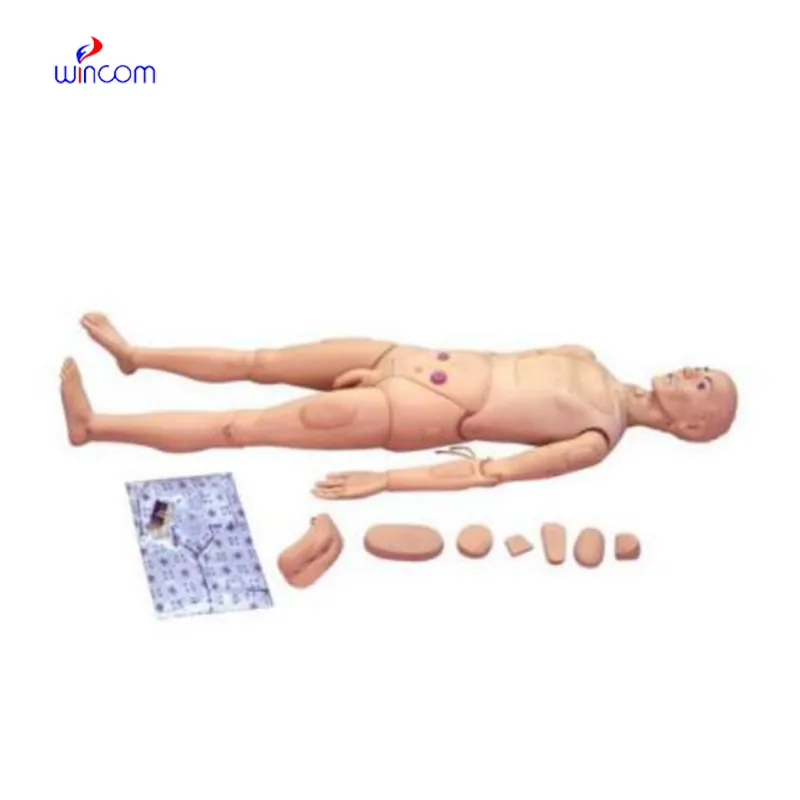
⭐ Recommended Multifunctional Nursing Torso Model | Wincom WN-M-800
Wincom's Multifunctional Emergency Nursing Training Simulator WN-M-800 is positioned for emergency nursing and care training, with practice functions covering hair and face washing, arm venipuncture, injection and transfusion training, deltoid injection, external femoral muscle injection, enema practice, male and female catheterization, male and female bladder flushing, whole-body care such as scrubbing and clothing changes, and movable limb joints for bending, rotation, and up-down motion. This makes it useful for physiology labs that want one training model to support both body-system explanation and repeated nursing procedure practice.

That combination is especially useful for programs with limited room or budget. Instead of buying one torso for anatomy and another model for every nursing task, a multifunctional simulator can support several teaching stations. Instructors can discuss the urinary system, then move into catheterization or bladder flushing practice. They can review muscle injection sites, then let students practice deltoid or external femoral injection technique.
Procurement teams should still verify the exact model configuration, replacement parts, and training scope before ordering. Simulation equipment is not a substitute for clinical supervision, but it reduces early learner anxiety and gives students a safer place to make and correct mistakes.
Physiology labs often overlap with skills labs, particularly in nursing and emergency-care education. A torso model or nursing simulator can help students understand why injection angle, site selection, vein access, and infusion flow are not just mechanical tasks. They are tied to tissue layers, circulation, patient comfort, and risk control.
For example, deltoid injection practice helps instructors review muscle boundaries and safe placement. External femoral muscle injection practice connects lower-limb anatomy with medication administration. Arm venipuncture and injection-transfusion training link vascular access with circulatory physiology and aseptic technique.
From a buyer's perspective, the questions are practical: Can the model withstand repeated puncture practice? Are consumable or replaceable parts available? Is the training area realistic enough for the course level? Can the model be cleaned between groups? These details affect teaching efficiency more than broad product claims.
A torso model in a physiology lab can also support care workflows that are easy to underestimate. Washing the face, assisting hygiene, changing clothing, repositioning the body, and moving limbs are not simply comfort tasks. They teach body mechanics, pressure-area awareness, dignity in care, and the link between musculoskeletal movement and daily patient support.
When a model includes movable limb joints, instructors can demonstrate bending, rotation, and controlled movement without placing early learners in awkward peer-practice situations. Students can rehearse sequence, hand placement, and communication before they work with real patients. For emergency nursing courses, this matters because poor technique can create discomfort or risk even during basic care.
This use also benefits high-volume teaching centers. A durable torso model allows multiple student groups to practice the same workflow consistently. That consistency helps instructors evaluate technique, compare performance, and standardize assessment across classes.
| Lab Use | Teaching Value | What Buyers Should Check |
|---|---|---|
| Organ location | Links anatomy to physiology | Removable parts, labels, stable assembly |
| Injection and venipuncture | Connects tissue and vascular concepts to skills | Durability, replaceable pads, cleaning method |
| Catheterization and bladder flushing | Supports urinary-system teaching and procedure rehearsal | Male/female training scope and fluid handling |
| Patient care practice | Builds workflow confidence before clinical placement | Joint movement, surface finish, ease of handling |
One overlooked use for a torso model is assessment. Instructors need a fair way to evaluate whether students can identify structures, explain body-system relationships, and perform basic procedures in the correct order. A standardized model gives every learner the same physical reference, which makes demonstrations and practical exams easier to compare.
This is helpful in labs with rotating instructors or large student groups. A consistent torso model supports checklists for organ identification, injection-site selection, catheterization sequence, hygiene workflow, and patient-positioning steps. It also helps instructors spot patterns and adjust teaching before clinical exposure.
For distributors and institutional buyers, this assessment value can be part of the purchasing argument. A good model supports course delivery, student practice, instructor demonstration, and exam preparation. That broader value is often easier to justify than a purchase based only on anatomy display.
Before selecting a model, define the course outcomes. A general anatomy course may only need removable organs and clear labels. A nursing physiology course may need injection, catheterization, venipuncture, enema, and whole-care functions. A training center serving hospitals or emergency-care programs may need a more robust multifunctional simulator.
Buyers should also review maintenance requirements. Ask about cleaning methods, storage, expected wear areas, spare parts, packaging, lead time, and after-sales support. For international procurement, documentation and communication speed matter because delays can disrupt semester planning. Wincom's broader human models category, medical equipment range, and laboratory equipment portfolio give purchasing teams a useful starting point when building a combined teaching-lab order.
For supplier evaluation, look beyond the single product page. Review the company background, product categories, contact options, and inquiry process. Wincom presents itself as a medical and laboratory equipment exporter with more than 30 years of international business experience and buyer relationships across 50 countries and regions, which may be relevant for institutions comparing export suppliers. As with any medical training purchase, confirm final specifications, accessories, warranty terms, and shipment details before issuing a purchase order.
If your lab needs a torso model that supports both anatomy explanation and practical nursing procedures, review the Wincom WN-M-800 configuration and ask for current availability, accessories, packing details, and quotation support.
[Contact Wincom for Your Customized Quotation]It is used to teach organ location, body-system relationships, clinical skill preparation, patient-care workflows, and practical assessment. More advanced nursing simulators can also support procedures such as injection, venipuncture, catheterization, enema practice, and bladder flushing.
It depends on the model. A simple anatomical torso is useful for structure and orientation, while a multifunctional nursing simulator is better for repeated procedure practice. Instructors should match the model to course outcomes and clinical supervision requirements.
Verify the exact training functions, removable or replaceable parts, cleaning method, surface durability, accessories, packing, lead time, warranty terms, and whether the model fits the intended course level.
A torso model earns its place in a physiology lab when it helps students connect structure, function, and care. Choose the model around the skills your learners must master, then confirm the details that affect daily teaching: durability, cleaning, replacement parts, and supplier support.
E-mail: [email protected]
Tel: +86-731-84176622
+86-731-84136655
Address: Rm.1507,Xinsancheng Plaza. No.58, Renmin Road(E),Changsha,Hunan,China


 EN
EN
 af
af
 es
es
 ar
ar
 tr
tr
 sw
sw
 pt
pt
 th
th
 ur
ur
 bn
bn
 ne
ne
 vi
vi
 km
km
 lo
lo
 de
de
 ru
ru
 fi
fi
 nl
nl
 fa
fa
 fr
fr
 ko
ko