
Blog
The use of quality transport equipment is always a necessity for the safe and secure movement of sensitive devices like instruments, samples, etc., in hospitals and laboratories. Among the various such tools, instrument trolleys are the most important and basic ones, as they support the whole daily work of the mentioned places. However, one question always pops up for the buyers and acquisition teams - should one opt for a stainless steel or a plastic instrument trolley?
This decision has a far-reaching impact; not only the operational efficiency would be affected but also the safety, durability, and compliance with regulations in the long run. In the case of exporters, choosing the right material becomes even more critical since the different international standards and usage conditions may create subtle differences in customer expectations. Awareness of these factors allows a hospital or laboratory to make a reassured and well-supported decision.
Heaviest medical devices, sealed containers and diagnostic instruments are some of the items that most hospitals and laboratories have to move around. The right trolley needs to accommodate the maximum weight requirements without any risk of being bent, cracked or tipped over while being moved.
Thorough cleaning is performed in high-risk areas. The materials should keep their structural integrity and cleanliness after being subjected to repeated disinfections.
The longevity factor directly affects the cost efficiency of the purchase; therefore, the buyers must consider the type of material being used for the trolley in terms of its resistance against impact, abrasion, and exposure to the environment over years of being used daily.
Among the features required are smooth motion, stable wheels, and comfortable handles. The total weight of the trolley also plays a part in the ability to deal with tight spaces or walkways that are heavy with traffic.
There is a variation in budgets, and the people making the decisions have to compare the expenses of replacement or repair in the long run against the savings made in the short term.
Moreover, exporters will have to make sure that their products meet international certification requirements like ISO, CE, or FDA compliance. The use of fully compliant materials facilitates documentation and speeds up customs clearance.
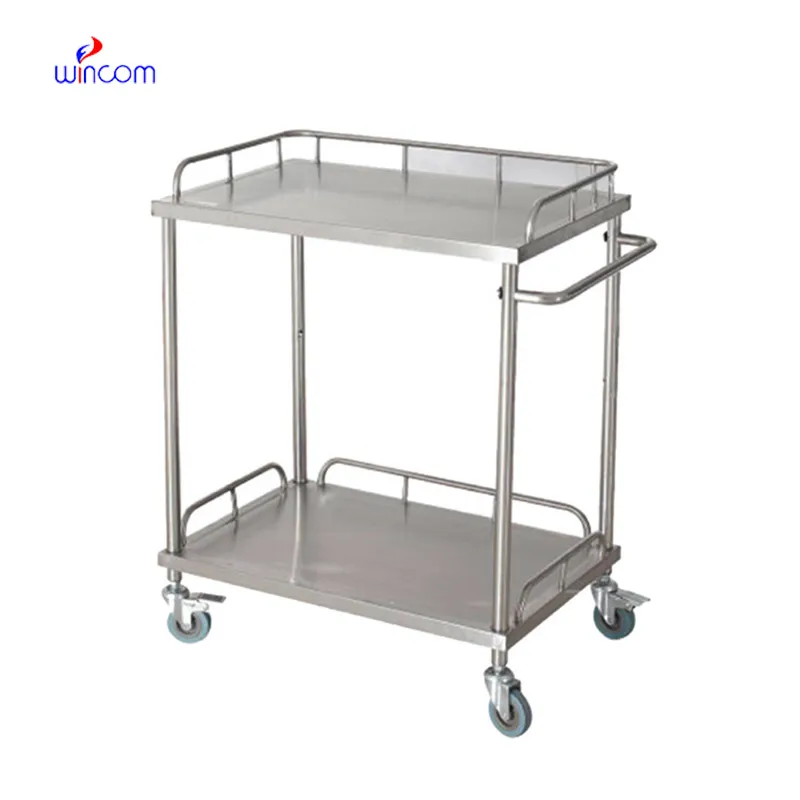
It provides great stability not only by resisting rust but by also resisting moisture and exposure to chemicals. It maintains the reliability of the structure during the most demanding loads and the most severe sterilization processes.
Its strong structure, on the other hand, makes it possible to operate with high loads, thus it is suitable for surgical suites, research laboratories, and diagnostic departments where heavy equipment is used.
This property does not only apply to high temperatures and vapors but also to aggressive chemicals without the loss or change of hygiene.
The smooth, bright surface of stainless steel is in line with the expectational look of hospitals and laboratories, thus accentuating the attributes of professionalism and security.
Stainless steel trolleys, though initially costly, are built to last for several years, hence minimizing the frequency of replacements while keeping the running costs low.
Plastic is much lighter compared to stainless steel, hence allowing fast movement and giving minimal fatigue to staff.
Smaller clinics and teaching laboratories welcome plastic trolleys due to their affordability, especially when heavy-duty performance is not required.
Some plastics are resistant to chemical spills and stains from many non-corrosive cleaning agents, hence applicable in those respective fields.
Plastic trolleys could be produced in different colors, styles to support color-coded workflows or even brand-specific designs.
In humid or light conditions, plastic is sufficiently durable but at a lesser cost.
With stainless steel, the resistance to damage and corrosion is greater, offering significantly longer service life. Plastic can wear more quickly, especially under continuous heavy loads.
Stainless steel tolerates high-temperature sterilization and aggressive disinfectants. Plastic usually needs manual cleaning and does not tolerate extreme heat.
Plastic has low entry cost, while stainless steel offers stronger long-term value through reducing the frequency of repairs and replacements.
Plastic trolleys are lighter and, thus, easier to push. The models made of stainless steel have higher strength but require greater effort while moving, especially when fully loaded.
Exporters have to consider such things as packaging, freight weight, and preferred materials of target regions. Some markets favor stainless steel for medical compliance, while others prefer plastic due to budgetary or logistics concerns.
The facilities that have highly demanding work and require a high level of sterilization can benefit most by using stainless steel.
Plastic is a practical choice when loads are light and budgets limited.
Exporters often combine material choice with optimized packaging to reduce freight expenses while maintaining compliance.
It helps to comprehend the client's needs and recommend the right material based on workload, budget, and intended usage.
ISO, CE, or FDA compliance guarantees smoother import procedures, while at the same time encouraging customer trust.
Characteristics such as shock-absorbing materials, moisture-proof wrapping, and reinforced crates help in maintaining product integrity during transit.
Both stainless steel and plastic instrument trolleys present clear advantages, and the best option depends on the environment, workload, and regulatory demands of the user. Exporters will have much to gain from offering diverse material options to meet different market needs. Buyers can confidently choose the most suitable solution after considering load requirements, hygiene standards, and compliance expectations regarding long-term value.
🔗 Visit us for more instrument
They resist high-temperature sterilization, corrosion resistance, and offer support to heavy medical equipment constantly.
Yes, they are good for low-load jobs and transportation of light equipment, especially in educational or small labs.
Stainless steel has a longer service life and lower replacement rate, hence giving better long-term value.
Different markets have differing demands on compliance documentation for stainless steel equipment; some will more easily accept plastic due to the lower cost.
The trolley should be made from stainless steel with reinforced frames and medical-grade wheels for stability and safety.
E-mail: [email protected]
Tel: +86-731-84176622
+86-731-84136655
Address: Rm.1507,Xinsancheng Plaza. No.58, Renmin Road(E),Changsha,Hunan,China


 EN
EN
 af
af
 es
es
 ar
ar
 tr
tr
 sw
sw
 pt
pt
 th
th
 ur
ur
 bn
bn
 ne
ne
 vi
vi
 km
km
 lo
lo
 de
de
 ru
ru
 fi
fi
 nl
nl
 fa
fa
 fr
fr
 ko
ko



