
Blog
In modern healthcare systems, selecting an anesthesia machine is no longer a routine procurement task. It is a strategic clinical infrastructure decision that directly impacts:
The evaluation process for hospitals, surgical centers and international medical distributors requires assessment of both essential system functions and four additional criteria, which include system reliability, ventilation system adaptability, international standard compliance, and system maintenance support for extended periods.
The worldwide expansion of surgical access creates an increasing need for contemporary anesthesia workstations that integrate established clinical proof with modern engineering standards.
The historical development of anesthesia machines provides essential background information that helps buyers find reliable systems that meet international healthcare requirements for export markets.
The history of anesthesia technology began in 1846 with the public demonstration of ether anesthesia by William T. G. Morton at Massachusetts General Hospital.
Early anesthesia devices were simple inhalers relying on passive evaporation of ether. These systems:
Such limitations created safety risks and unpredictable surgical outcomes.
These early challenges led to innovations in vaporization control and multi-agent inhaler systems—laying the foundation for controlled anesthesia delivery.
Buyer Insight:
The historical lack of precision explains why modern vaporization accuracy and gas flow stability are now essential purchasing criteria.
In the early 1900s, the first gas anesthesia systems began to operate. The machines provided anesthetists with the capacity to administer anesthetic gases without needing their patients to breathe on their own.
This marked a major transformation:
The development of mechanical ventilation systems brought about better anesthesia equipment, which enabled doctors to provide patients with respiratory assistance during their operations.
The anesthesia workstation concept emerged during this time as a multifunctional system that integrated gas delivery with ventilation and monitoring functions.
Industry Impact:
The operating room infrastructure underwent a complete transformation when medical technology advanced from single-function devices to integrated platforms.
Today’s anesthesia machine is a highly integrated clinical system combining:
Contemporary anesthesia workstations provide support for both adult and pediatric medical procedures through their various available ventilation modes which include:
The system provides real-time monitoring capabilities, which track tidal volume, respiratory rate, and airway pressure and oxygen concentration levels to increase safety during medical procedures.
The Anesthesia Machine AM-2000B system combines its ventilation function with gas control and monitoring capabilities to deliver a compact workstation solution that meets current operating room requirements.
Buyer Insight:
Integrated design reduces reliance on multiple standalone devices, lowering space requirements, training complexity, and maintenance costs.
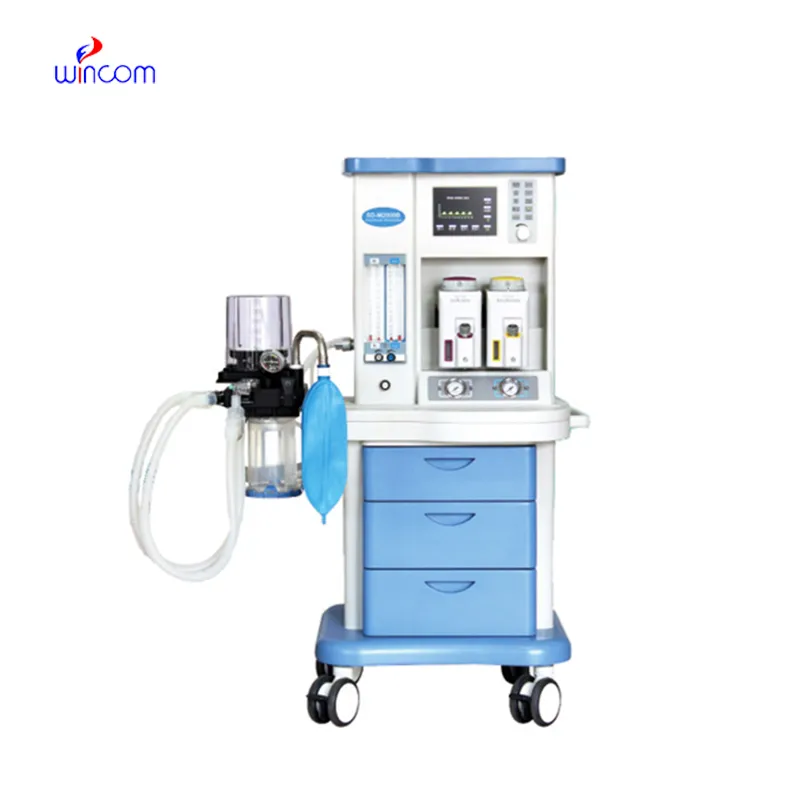
Modern export-ready anesthesia machines incorporate several defining innovations:
Advanced vaporizers compensate for temperature, pressure, and flow variations to ensure stable anesthetic output—addressing historical evaporation instability.
Multi-level visual and audible alarms monitor:
This dramatically reduces perioperative risk.
Modern systems combine manual and automatic ventilation modes, enabling use across general surgery, emergency procedures, and specialized applications.
Built-in battery systems ensure continued operation during power interruptions—essential in regions with unstable power infrastructure.
For detailed system specifications, see the AM-2000B Anesthesia Machine technical overview.
These engineering features increase uptime, enhance reliability, and align with international safety standards.
The anesthesia machine has evolved from a mechanical gas delivery device into:
Modern systems incorporate electronic flow sensors, digital displays, and integrated monitoring—supporting data-driven clinical decision-making.
This transformation parallels global healthcare trends emphasizing precision, automation, and integrated monitoring systems.
Understanding historical development enables smarter procurement decisions.
| Historical Challenge | Modern Solution | Procurement Benefit |
|---|---|---|
| Inconsistent dosage | Digital flow control | Predictable anesthesia delivery |
| Manual observation | Real-time monitoring | Reduced clinical risk |
| Single-function devices | Integrated workstations | Higher ROI |
| Mechanical instability | Precision-engineered components | Extended service life |
Buyers should assess systems not only by initial price, but by:
When importing or distributing anesthesia machines, prioritize:
Systems designed for international markets must also consider:
These criteria reflect lessons learned from nearly two centuries of medical engineering advancement.
The anesthesia machine’s journey from its basic 19th-century inhaler design to its current advanced digital systems shows how medicine developed through its most significant technological progress.
The basic evaporation device that scientists created has now developed into a surgical equipment platform that enables precise control while ensuring safety during medical procedures.
The modern anesthesia machine represents more than an equipment purchase for hospitals, surgical centers, and global distributors; it is participation in a long-standing legacy of innovation designed to make surgery:
Selecting the right system ensures both clinical excellence and long-term operational sustainability.
The development of anesthesia devices started with William T. G. Morton, who demonstrated ether anesthesia to the public in 1846.
The system was developed through several stages, which began with basic inhalers and progressed to gas-controlled systems and eventually reached digital anesthesia workstations.
The system includes precise vaporization technology, multiple ventilation modes, built-in monitoring systems, alert mechanisms, and an emergency power system.
The system provides essential respiratory and gas monitoring data, which allows medical staff to monitor patient safety throughout the surgical procedure.
Distributors require products that maintain stability while meeting international standards, providing flexible ventilation options, durable performance, and extended maintenance support.
E-mail: [email protected]
Tel: +86-731-84176622
+86-731-84136655
Address: Rm.1507,Xinsancheng Plaza. No.58, Renmin Road(E),Changsha,Hunan,China


 EN
EN
 af
af
 es
es
 ar
ar
 tr
tr
 sw
sw
 pt
pt
 th
th
 ur
ur
 bn
bn
 ne
ne
 vi
vi
 km
km
 lo
lo
 de
de
 ru
ru
 fi
fi
 nl
nl
 fa
fa
 fr
fr
 ko
ko



