
Blog
Selecting the appropriate crutch type is an important part of post-surgical rehabilitation planning. Different crutch designs offer distinct advantages depending on patient condition, balance, and expected recovery duration.
Patients commonly require crutch assistance following:
When used correctly, crutches help patients:
Choosing the right crutch type for patients can help optimize mobility training and enhances patient safety.
Most hospitals around the world use axillary crutches as their standard walking aid. The crutches extend under the patient’s arms and deliver support through both the underarm pad and hand grip.
Axillary crutches are often prescribed during the early stages of rehabilitation when patients require maximum support and stability.
Primary features include:
Axillary crutches are particularly helpful for patients who:
Because the learning curve is relatively simple, most patients can quickly understand how to use axillary crutches safely.
The use of axillary crutches during initial rehabilitation processes offers benefits but results in problems for users who need to use the equipment for extended periods. Users experience discomfort because continuous pressure affects their underarm region, which results in nerve and blood vessel compression. The medical condition known as crutch palsy occurs when a person puts too much weight on their armpits.
Many rehabilitation specialists recommend that patients change to other assistive devices after they achieve their required strength and stability level.
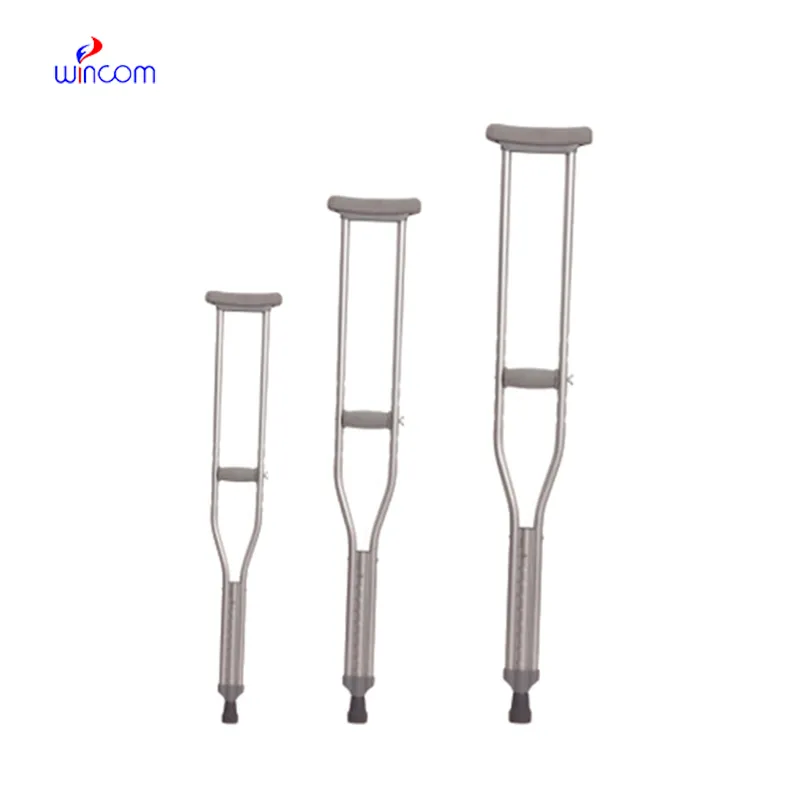
In European rehabilitation systems, forearm crutches serve as common equipment that modern physiotherapy programs throughout the world now start to use.
Forearm crutches provide body support through an arm cuff system, which pairs with a hand grip for user control, while axillary crutches employ a different method of support.
This design allows weight to be distributed more evenly across the arm rather than concentrating pressure under the shoulder.
Key benefits include:
Forearm crutches enable patients to walk with their body movements. This feature is particularly useful during the later stages of rehabilitation when patients transition back to their normal walking patterns.
Physiotherapists often prefer forearm crutches for gait retraining programs because natural movement restoration stands as their main objective.
Patients using forearm crutches experience better freedom to move their bodies. Users can maintain forearm control through the cuff attachment, which enables them to release the handgrip without dropping the crutch. This design makes daily activities easier to perform.
Healthcare providers evaluate several clinical factors before prescribing a mobility aid.
Orthopedic surgeons usually define weight-bearing levels after surgery. Common protocols include:
Axillary crutches are often preferred during strict non-weight-bearing phases because they provide maximum stability.
Patients with reduced upper-body strength or poor balance may benefit from the additional stability offered by axillary crutches. This group often includes:
Rehabilitation timelines also influence equipment selection.
Typical recovery periods include:
Forearm crutches are generally more suitable for longer recovery programs.
When evaluating the effectiveness of crutch types, clinicians are often concerned about several performance indicators.
Axillary crutches provide superior stability during the initial post-operative phase. Their wider support structure helps patients maintain balance while learning new movement patterns.
The extended period of using axillary crutches leads to underarm discomfort. Forearm crutches create better weight distribution across the arm than standard crutches.
Forearm crutches typically promote a smoother and more natural walking pattern. This characteristic is valuable during advanced rehabilitation stages when restoring normal gait mechanics becomes a priority.
Choosing the appropriate crutch can reduce several risks, which include:
Many rehabilitation centers now adopt a phase-based mobility strategy.
During the first phase after surgery, the primary goals are stability and protection of the surgical site.
Recommended device: Axillary crutches
As the patient’s strength improves, clinicians may allow partial weight bearing.
Both crutch types may be used during this transition phase.
When patients begin gait retraining and functional mobility exercises, forearm crutches often become the preferred option.
Recommended device: Forearm crutches
This staged approach allows patients to progress safely through each phase of recovery.
When selecting rehabilitation equipment, healthcare facilities typically evaluate several key factors.
Important procurement criteria include:
Hospitals that work with experienced medical equipment suppliers can build comprehensive rehabilitation programs that improve patient outcomes.
Successful recovery after orthopedic surgery depends on more than surgical technique. Weight-bearing activities require controlled management together with suitable mobility assistance to achieve effective rehabilitation.
Both axillary and forearm crutches play important roles in post-operative care. The early recovery phase benefits from axillary crutches, which deliver strong stability, while patients require forearm crutches to achieve better comfort and mobility during their long-term rehabilitation.
Healthcare professionals achieve better recovery results through their selection of proper devices at each recovery stage because it leads to:
The Arm Crutches WN7500-L solution establishes a stable mobility system that enables contemporary rehabilitation facilities to assist patients in achieving both independence and confidence throughout their recovery process.
Axillary crutches provide support under the arms and are commonly used during early recovery stages, while forearm crutches support the body through a cuff around the forearm and are more suitable for long-term mobility.
The best choice depends on the rehabilitation stage. Axillary crutches are often used during strict non-weight-bearing periods, while forearm crutches are preferred for later mobility training.
Many patients find forearm crutches more comfortable during long-term use because they distribute weight more evenly across the arm.
Yes. Many rehabilitation centers use a staged approach where patients start with axillary crutches and later transition to forearm crutches as recovery progresses.
Hospitals should evaluate product durability, ergonomic design, adjustable height range, safety certifications, and supplier reliability.
E-mail: [email protected]
Tel: +86-731-84176622
+86-731-84136655
Address: Rm.1507,Xinsancheng Plaza. No.58, Renmin Road(E),Changsha,Hunan,China


 EN
EN
 af
af
 es
es
 ar
ar
 tr
tr
 sw
sw
 pt
pt
 th
th
 ur
ur
 bn
bn
 ne
ne
 vi
vi
 km
km
 lo
lo
 de
de
 ru
ru
 fi
fi
 nl
nl
 fa
fa
 fr
fr
 ko
ko